> *— by **Sky Zou**, Chairman, SKYW Fund*
Over recent weeks, in conversations with Hong Kong bankers, family offices, brokers and financial professionals, one line keeps surfacing — half serious, half tongue-in-cheek: *"Middle Eastern capital has probably poured USD 300 billion into Hong Kong."*
That number carries market sentiment and the exaggeration typical of finance circles. But the more often I hear it, the more it begs a serious question: why is nearly every Hong Kong finance professional talking about *capital reflow*, *family offices accelerating their arrival*, and *Middle Eastern clients rebalancing their Asian allocations*?
The real story, in my view, is not whether the USD 300 billion figure is literal. It is the shift in market perception behind it: **Hong Kong is being repriced by global capital.**
This repricing is not built on rumour. It rests on a set of mutually reinforcing signals — deposit inflows, family office growth, rebounding IPOs, declining vacancy in Central Grade-A offices, financial institutions expanding again, and the rollout of stablecoins and tokenized financial infrastructure. Crucially, these changes are not isolated. They arrive together, against a backdrop of rising global uncertainty, a prolonged Middle East conflict, and capital searching anew for safety and liquidity.
Having spent years between Shenzhen and Hong Kong — working on corporate financing, M&A, and cross-border capital coordination — I can feel more sharply than ever that Hong Kong is no longer simply an international financial centre in the old sense. It is becoming a more complex and more consequential node: the interface between China and the world, the bridge where industry and capital recombine, and potentially a decisive piece of the next generation of global financial infrastructure.
## I. More important than "300 billion" — why capital is looking at Hong Kong again
Markets love to compress complex trends into a single headline number. Professional judgment does the opposite. Rather than asking *"has the 300 billion actually arrived?"*, look at five more substantive questions: are deposits growing, is market activity rising, are family offices clustering, is the core financial district recovering, and is institutional innovation landing?
Public data says yes on all five.
On 23 November 2025, Hong Kong's Financial Secretary Paul Chan said explicitly that geopolitical shifts had turned Hong Kong into a safe haven — total bank deposits already exceeded HKD 19 trillion. On 5 April 2026 he returned to the theme: against the persistent shadow of Middle East conflict, Hong Kong's Q1 IPO proceeds surpassed HKD 103 billion — world-leading — while March daily turnover exceeded HKD 300 billion. Investors, he said, now see Hong Kong as a reliable safe harbour.
This wave is not sentiment running on empty — it has been validated at three levels: official statements, the banking system, and the capital markets.
## II. The real signal — multiple indicators starting to resonate
**Deposits.** On 31 March 2026, the HKMA reported February 2026 deposits up 0.9%, with foreign-currency deposits up 1.7%. For full-year 2025, total deposits rose 11.8%. Capital is not just churning equities; it is settling into the banking system.
**The HK dollar.** In early May 2025, the peg's strong-side convertibility undertaking triggered four times. The HKMA bought USD 16.7 billion and sold HKD 129.4 billion. HKMA Chief Executive Eddie Yue was clear: HKD demand was driven by rising capital-markets activity, southbound net inflows, large IPOs and dividend cycles. Not "war in the Middle East directly lifted the HKD" — but evidence that this international liquidity pool is absorbing and reflecting global flow changes.
**Family offices.** By September 2025 the government announced — with InvestHK's assistance — that over 200 family offices had established or expanded in Hong Kong, ahead of schedule. By February 2026, Deloitte research counted more than 3,380 single-family offices at year-end 2025, about 680 new arrivals in two years — a 25%-plus increase. This is not loose capital; it is the entire ecosystem of wealth management, asset allocation, and intergenerational transfer.
**Central.** JLL data show February 2026 Central Grade-A office vacancy falling to 10.1% — the lowest since 2023. By 19 March it fell further to 9.9%, with two-month rent cumulatively up 3.5%. This is not a broad commercial real-estate reversal, but a clear signal: the core financial district is recovering, led by financial institutions. Capital-markets strength is moving from screens to floor plates, meeting rooms, and desks.
## III. Why Hong Kong matters more in both scenarios
My view of Hong Kong is straightforward.
**If global geopolitics stabilises and China keeps growing — Hong Kong does very well.**
**If global geopolitical conflict intensifies — Hong Kong may do even better.**
It sounds paradoxical, but it captures Hong Kong's dual value.
In the first scenario, Hong Kong benefits from the certainty of Chinese growth. The best of China's tech, manufacturing, new-energy and services platforms need international financing, global pricing, cross-border M&A, and a venue to meet offshore investors. Hong Kong remains the place closest to Chinese industry that also has the strongest interface with international capital rules. Continued Chinese development, ongoing industrial upgrading, and expanding overseas deployment all mean sustained project, capital, talent, and institutional dividends for Hong Kong.
In the second scenario, Hong Kong benefits from a safety premium born of global instability. When conditions worsen, capital looks not just for yield, but for safety, liquidity, and predictability — and that is precisely Hong Kong's scarce combination.
Under "One Country, Two Systems", Hong Kong is backed by China's most complete industrial system and largest growth hinterland, while preserving common-law institutions, freely convertible currency, internationally integrated financial markets, and a global professional services network. It is not simply "furthest from risk" — it is one of the few places that can simultaneously connect Chinese opportunity with international rules and handle both safety and growth needs.
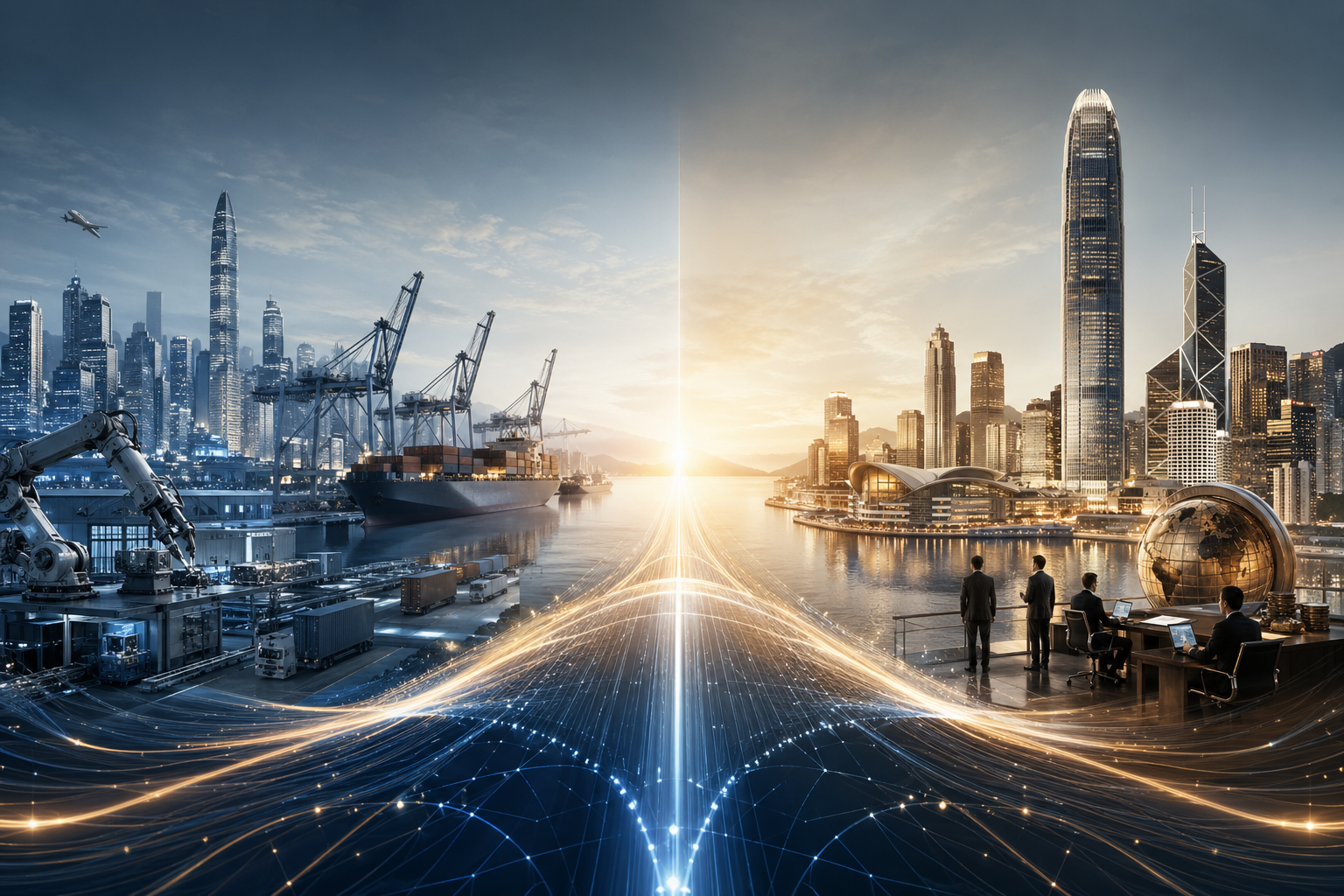
Hong Kong's real value is not merely a safe port but a *bridge*. It translates Chinese industrial capability into financial forms that global capital can understand, allocate, and trade. It also reconnects global capital, legal, technological, insurance, settlement, and wealth-management capabilities back to Chinese and Asian industrial networks. If Shenzhen is the engine of technology, manufacturing, and innovation use-cases, Hong Kong is the interface layer translating those capabilities into global financial language.
## IV. Hong Kong's next layer is not finance — it is financial infrastructure
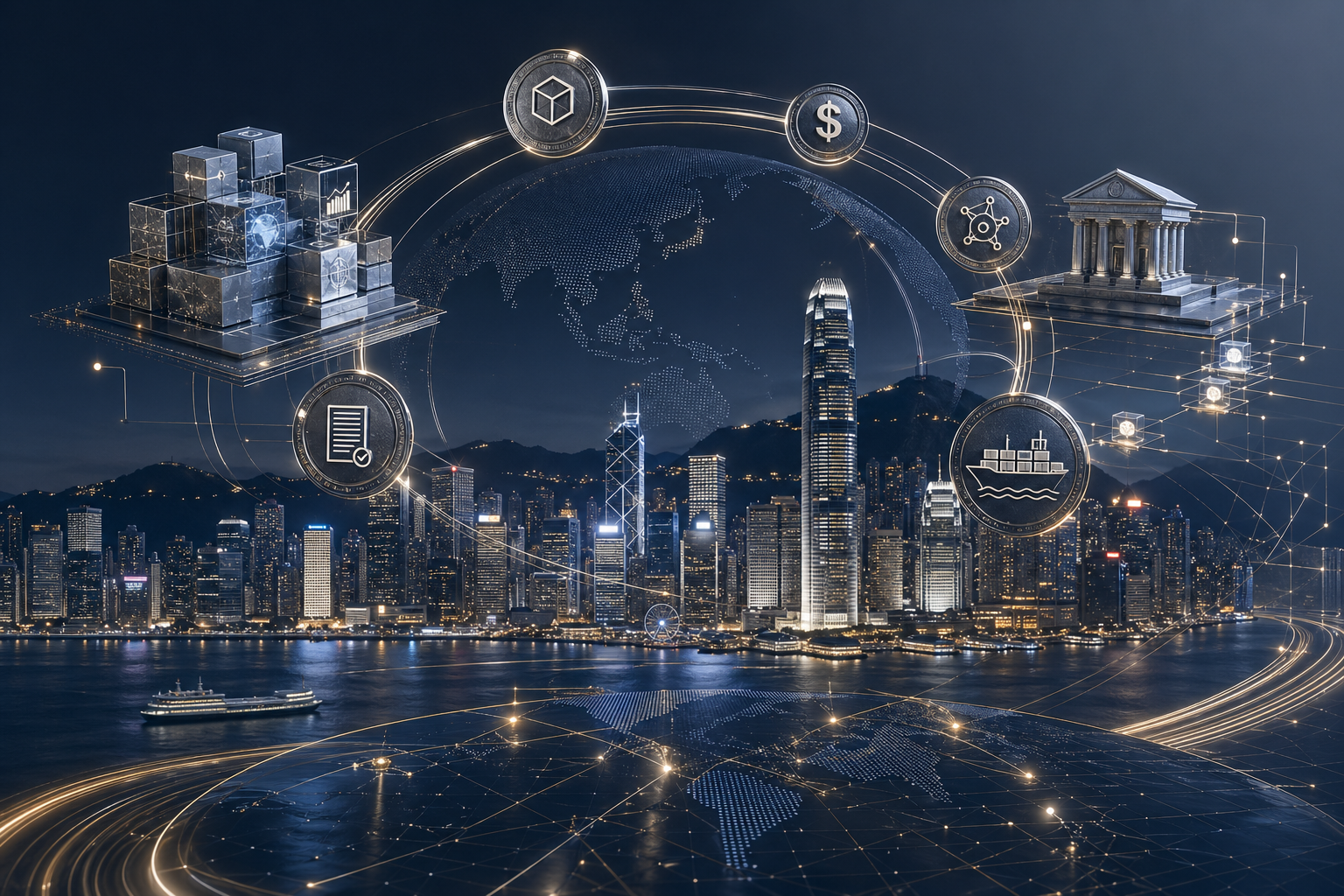
Many discussions of Hong Kong stop at equities, property, HKD, and banking. But that misses the other major shift underway: **Hong Kong is positioning itself in the next generation of global financial infrastructure.**
The keywords are not vague Web3 rhetoric, but specific ones: **stablecoins, tokenized deposits, RWA, electronic bills of lading, trade and supply-chain finance.**
May 2025: Hong Kong passed the Stablecoins Bill. 1 August 2025: the stablecoin issuer regulatory regime took effect. 10 April 2026: the HKMA issued its first stablecoin issuer licences. In parallel, HKMA's *Project Ensemble* has — since 2024 — explicitly tested tokenized real-world assets, electronic bills of lading, and trade & supply-chain finance, entering live-trading pilot in November 2025.
The implication is significant. Hong Kong is not competing only to have "more capital parked here" but for "more trading, more settlement, more asset issuance, and more global capital formation completed here". In the past, Hong Kong was the gate for capital flows. In the future, it is more likely to become the hub for asset-on-chain, payment restructuring, cross-border financing, and global liquidity reorganization.
This is why what matters is not just this cycle of sentiment — but the next repricing of institutions and infrastructure.
## Conclusion: What Hong Kong really offers is "safely connecting the world"
So, back to the opening question.
We should not be asking *"did the 300 billion really arrive?"*.
We should be asking: **why, in a more unstable world, does Hong Kong look more important?**
My answer: Hong Kong's scarcity has never been safety alone. It is the capability to **safely connect the world**.
It has both China's substance and the world's interface; both institutional stability and capital freedom; it serves today's equities, bonds, family offices, and banking — while securing positions for tomorrow's stablecoins, RWA, and next-generation trade-finance infrastructure.
If the world stabilises, Hong Kong benefits from China's continued development. If it grows more chaotic, Hong Kong becomes more valuable for its safety, stability, rules, and connectivity.
This is not an empty vision — it is a direction being validated, step by step, by reality itself.
Those who truly understand Hong Kong might begin to see it not as a **"window city"** but as an **"interface city"**.